Vietnam Transportation, News
Hundreds of Wild Tơ Dày Flowers Bloom Spectacularly in Mu Cang Chai
The rugged mountain landscapes of Mu Cang Chai in northern Vietnam have recently burst into vibrant color as countless wild tơ dày flowers unfurl their blossoms across hillsides and village surroundings, attracting travelers eager to witness this natural spectacle at the start of the year.
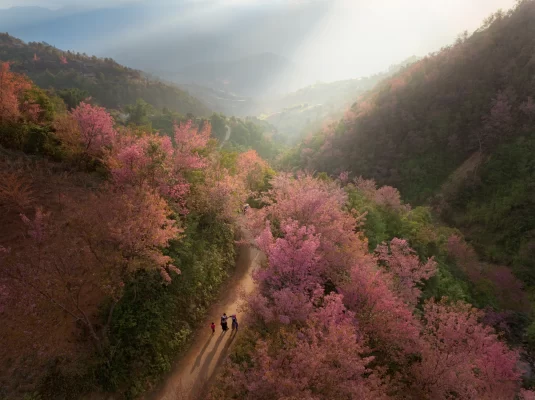
From mid-December onwards, the slopes around hamlets such as Mi Hang (in Mu Cang Chai Commune) and Trong Tong (in Pung Luong Commune) have been transformed into sweeping blankets of soft pink blooms.
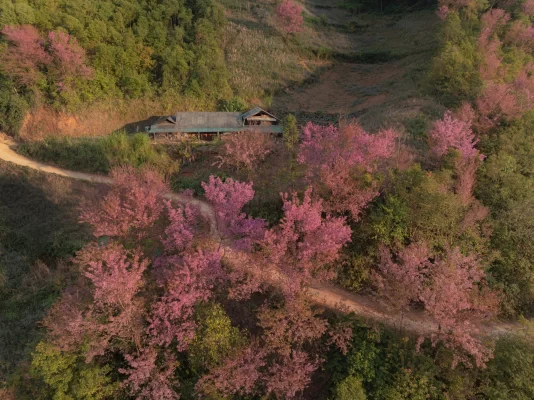
Beautiful Tơ Dày Flowers in Mu Cang Chai
A photographer from Hanoi, known as Vinh DAV, visited Mu Cang Chai in late 2025 and spent two days capturing the scene on December 27 and 28. He shared that during his stay, the best floral displays could be found in the Trong Tong area and, at the time of his departure, in the Hang Gang region.
“The sky was often cloudy while I was there, so the blossoms lacked a rich pink hue,” Vinh DAV explained. “I had to wait hours, watching the clouds and waiting for sunshine, just to catch that perfect moment to take the shot – and that felt like a reward for persistence.”
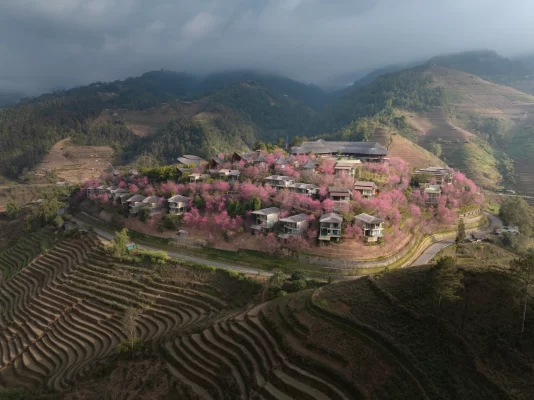
Beautiful Tơ Dày Flowers in Mu Cang Chai
What Are Tơ Dày Flowers?
Tơ dày belongs to a type of small woody tree that thrives at elevations above 1,000 meters (3,280 feet) and grows naturally in the highland communes of Mu Cang Chai, including the old administrative areas of Kim Noi, Mo De, Che Cu Nha, and across parts of Pung Luong – such as Nam Khat, La Pan Tan, De Xu Phinh, and the former Pung Luong itself.
Locals, especially the H’Mong ethnic community, call these blossoms “pằng tơ dày,” meaning forest peach flowers due to their resemblance to peach blossoms. These blooms are considered one of the signature wildflowers of the Northwest mountain region, heralding the approach of spring and the traditional lunar New Year for the H’Mong people — usually appearing roughly one month before Tết begins.
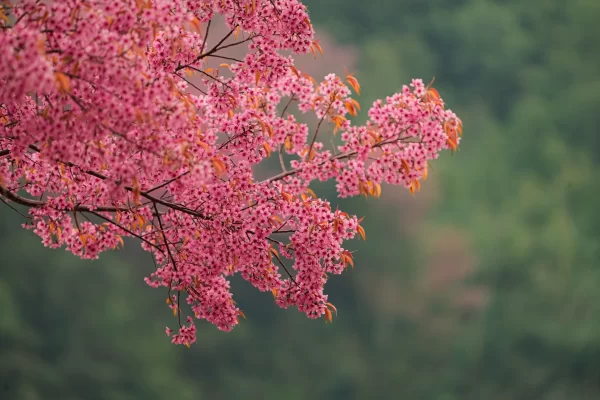
Each tơ dày flower has five slender petals, and compared to common garden peach blossoms, they are longer and more elongated — lending a delicate yet striking appearance to the hillsides they cover.
Beautiful Tơ Dày Flowers in Mu Cang Chai
When and Where to Experience the Blooms
The flowering season for tơ dày tends to unfold over several weeks, generally from January through February, depending on local weather conditions and elevation. Early in the season, blossoms often appear first at higher altitudes before cascading down to lower slopes in successive waves.
Most experts and local guides say that the most vibrant and breathtaking phase typically lasts about 7 to 10 days from the moment flowers first open – a window when the pink color is deepest and the scenery most enchanting.
Aside from Mi Hang and Trong Tong, many visitors also find spectacular views throughout areas of La Pan Tan, Nam Khat, De Xu Phinh, and other highland hamlets where trees grow wild across natural clearings and slopes.
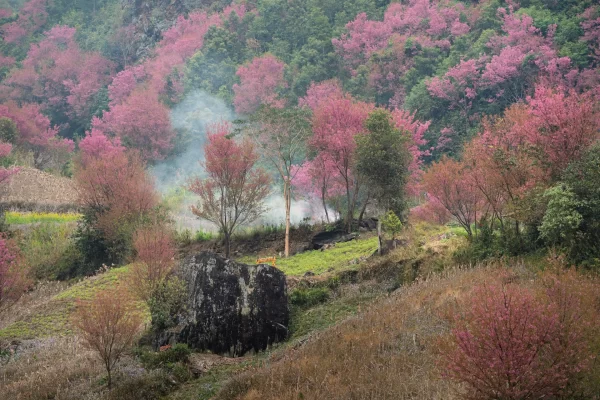
At times, the clusters of flowers seem to dance down the hillsides, creating a sea of soft pink that contrasts vividly with the deep greens and browns of forests and grasslands. On brighter days, the effect is particularly magical – a tableau reminiscent of springtime even amid winter’s cool air.
Beautiful Tơ Dày Flowers in Mu Cang Chai
Travel and Tourism Tips
While the blossoms themselves are a major draw, they represent only one of the seasonal highlights of Mu Cang Chai. The region also offers three notable natural spectacles throughout the year:
-
Tơ dày flower season (January–February)
-
Water-filled rice terraces (April–May)
-
Golden harvest rice fields (September–October)
Travelers planning a 2–3 day visit can combine a flower-watching adventure with other cultural or scenic experiences. Some popular add-ons include visits to the Tu Le Valley or Tram Tau – both known for their hot mineral springs and lush landscapes that provide soothing relaxation after long mountain drives.
In these mountainous areas, temperatures typically fluctuate between 10°C and 20°C (50°F–68°F) during the day – cozy but still cool enough to contribute to the intensity of the flower hues. Locals suggest shooting photos early in the morning or in the late afternoon, when sunlight is softer and adds depth to the floral colors.
For easier travel and navigation within the region, many visitors rent motorcycles from homestays or hire local drivers familiar with the winding mountain roads. Because the terrain includes steep gradients and narrow sections, riders are advised to have strong riding skills for safety.
Beautiful Tơ Dày Flowers in Mu Cang Chai
Cultural and Visual Delights
In villages like Trong Tong, you may see H’Mong children playing beneath glowing trees, while elders share stories of how each year’s bloom signals community celebrations and gatherings. The floral displays are not only a visual feast but also a cultural moment – a reminder of the connection between natural cycles and traditional life in the northwestern highlands.
Moreover, the region doesn’t stop at pink blossoms alone. At the same time the tơ dày flowers are in full bloom, fields of yellow canola flowers are also flourishing nearby – adding another dimension of color and drawing photographers and nature enthusiasts alike.
Ultimately, traveling to Mu Cang Chai for the tơ dày season offers far more than just a photo opportunity – it’s an immersive experience into highland culture, breathtaking mountain panoramas, and the rich, cyclical rhythms of rural Vietnam’s seasons.