News
The Sacred Peak of Ta Kou
The sacred peak of Ta Kou is a sanctuary of harmony, a place where the human spirit finds redemption in endless shades of green. Amid the sun and wind of the coastal lands between Binh Thuan and Lam Dong provinces, Ta Kou Mountain rises like a towering green pyramid, a miraculous oasis standing firm against time.
Standing at the foot of the mountain on a spring morning, when mist still drifts across the summit, visitors realize that Ta Kou is not merely a scenic destination but a living miracle preserved by human kindness and the sacred vitality of heaven and earth. The landscape evokes a profound sense of calm: forests breathing quietly, clouds clinging to rocky slopes, and the distant sound of temple bells resonating in the wind. In such a place, nature and spirituality intertwine so seamlessly that one cannot easily distinguish where the physical world ends and the sacred begins.
Thirty Years Guarding a Command from the Heart
Exactly thirty years ago, in 1996, Ta Kou once stood on the brink of life and death. At that time, deforestation had reached an alarming level: precious timber trees were felled, wildlife was relentlessly hunted, and dozens of hectares of mangrove forest in Tan Thanh were wiped out overnight. White stone on the mountain slopes was exploited indiscriminately. It seemed that this sacred mountain could be flattened at any moment if no urgent action was taken.
At that critical moment, the decision to recognize Ta Kou as a national nature reserve by the late Prime Minister Vo Van Kiet, known affectionately as “Mr. Sau Dan”, became a lifesaving buoy, an emergency command to protect the forest. According to Nguyen Ngoc Chinh, former Director of the Department of Home Affairs of the old Binh Thuan province, that decision preserved the integrity of the forests here and laid the foundation for long-term conservation.
Mai Van Quynh, former Director of the Ta Kou Nature Reserve, once recalled that Prime Minister Vo Van Kiet had a far-reaching vision for forest protection and development. During his field inspections, he repeatedly reminded local officials not to trade environmental values for short-term economic achievements, emphasizing that protecting forests meant safeguarding the nation’s future.
The “forest closure” policy in 1997 marked one of his most significant decisions, halting the merciless axes that threatened to destroy the ecosystem. Thanks to this decisive measure, Ta Kou still stands tall today, maintaining its ecological richness and sacred aura. The story of these protective policies serves as a reminder that environmental stewardship is not merely an administrative duty but a moral responsibility toward future generations.
Ta Kou is also listed as one of the world’s 221 most important ecological regions by the World Wide Fund for Nature (WWF), further confirming its global significance and the uniqueness of its biodiversity.
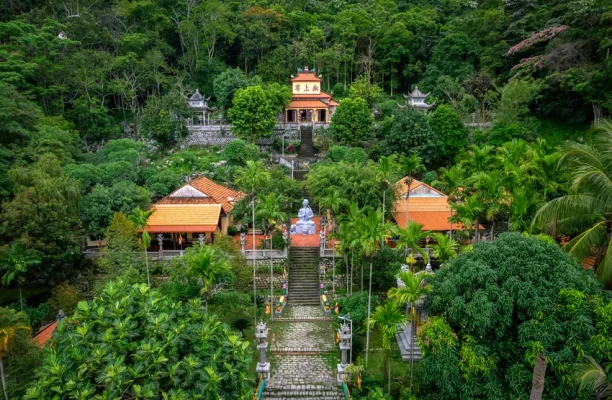
Linh Son, Truong Tho
The Extraordinary Residents of Ta Kou
Ta Kou is a living museum with a remarkably layered ecosystem. From the foothills to the summit, nature presents three distinct forest types, each hosting its own complex web of life. Scientists have recorded six species of primates here: the pygmy slow loris, the long-tailed macaque, the pig-tailed macaque, the red-faced macaque, the silver langur, and the black-shanked douc langur – graceful dancers of the great forest, many of which are listed in the Red Book of endangered species.
The mountain is home to as many as 178 species of vertebrates. Its ecological attraction is so powerful that international scientists such as Dr. Tony Gamble of the University of Minnesota and Vietnamese researcher Ngo Van Tri from the Institute of Tropical Biology in Ho Chi Minh City have spent sleepless nights deep in the forest under frost and mist. Their dedication was rewarded when they discovered endemic species found nowhere else on Earth, including the Ta Kou rock gecko (Gekko takouensis sp. nov., described by Ngo and Gamble).
This discovery followed an earlier finding in 2008, when Ngo Van Tri and Professor Aaron Matthew Bauer of Villanova University identified another endemic species, Cyrtodactylus takouensis. These discoveries highlight the mountain’s exceptional evolutionary significance and reinforce the importance of preserving its untouched habitats for scientific research and biodiversity conservation.
At the mountain’s base lies Bung Thi hot spring, a warm gift from Mother Earth discovered in 1957 by French scientist H. Fontaine. With temperatures approaching 90°C and rich mineral content, the spring has long been considered a natural source of healing energy. Nearby stands the legendary Master and Mistress Tree, associated with the compassionate couple known as Thay and Thim from Tam Tan village. According to local lore, they used forest herbs to heal people and spread kindness, leaving behind a spiritual legacy deeply rooted in the land.
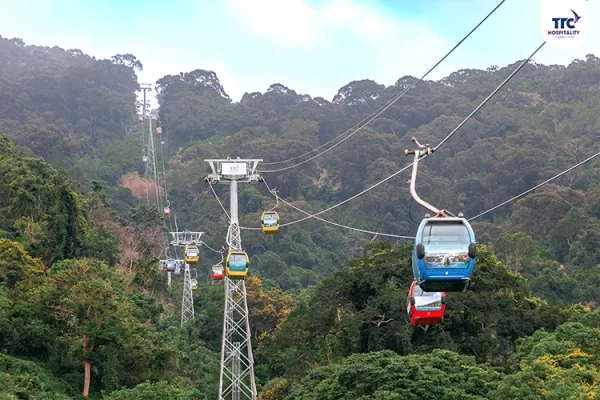
Cables on the peak of Ta Kou
Where Faith Is Carved into the Clouds
If the green forest forms the body of Ta Kou, then Linh Son Truong Tho Pagoda is its soul. More than 150 years ago, Patriarch Huu Duc opened the mountain and used medicinal herbs from its forests to cure the serious illness of Empress Dowager Tu Du. In gratitude, Emperor Tu Duc bestowed the pagoda’s name, honoring it with the four sacred characters “Linh Son Truong Tho,” meaning “Sacred Mountain of Long Life.”
The most magnificent symbol here is the 49-meter-long reclining statue of Shakyamuni Buddha entering Nirvana, the longest statue of serene repose in Asia. Constructed under rudimentary conditions, thousands of tons of materials were transported to the summit purely by human strength and unwavering faith. The feat itself stands as a testament to collective devotion and the deep spiritual bond between people and the mountain.
Miraculously, to obtain construction sand at such a high elevation, Abbot Thich Vinh Tho applied ancient wisdom to “summon sand” from underground water veins. Through prayer and careful use of natural water pressure, sand was filtered and gathered on-site—an ingenious hydraulic method that still earns admiration from scientists today.
Thirty years of protecting the forest and thousands of years of preserving spiritual values have shaped Ta Kou into more than just a protected site. It is guarded not only by laws but also by compassion and faith. The serene Buddha statue gazing down from the clouds seems to deliver a timeless message: when the mind is calm and human hands act kindly toward nature, that is the moment we touch Nirvana in the midst of earthly life.
Today, Ta Kou stands as both a natural sanctuary and a spiritual beacon. Visitors who journey here do not merely witness a beautiful landscape; they participate in a living narrative of conservation, belief, and harmony between humans and the environment. The mountain continues to inspire generations, reminding them that true sacredness lies not only in temples or statues but also in the enduring commitment to protect nature and nurture compassion in everyday life.