News
Blooming Kapok Flowers Paint the Countryside Red on the Outskirts of Hanoi
Located along the gentle flow of the Day River, a row of ancient kapok trees in Doan Nu Hamlet, My Duc District, Hanoi, sheds its leaves and bursts into brilliant red bloom, signaling the seasonal transition and the beginning of a new agricultural cycle.
About 50 kilometers from central Hanoi, Doan Nu Hamlet presents the classic scenery of the Northern Delta countryside. Here, around 20 ancient kapok trees bloom simultaneously in mid-March. Unlike the scattered growth commonly seen elsewhere, these trees are planted in a continuous line stretching more than 500 meters, forming a striking red corridor along the edge of vast rice fields.
This unique landscape has long been a familiar and beloved image for locals, but in recent years, it has gained wider recognition through photography and social media, attracting visitors eager to witness the vivid seasonal transformation.
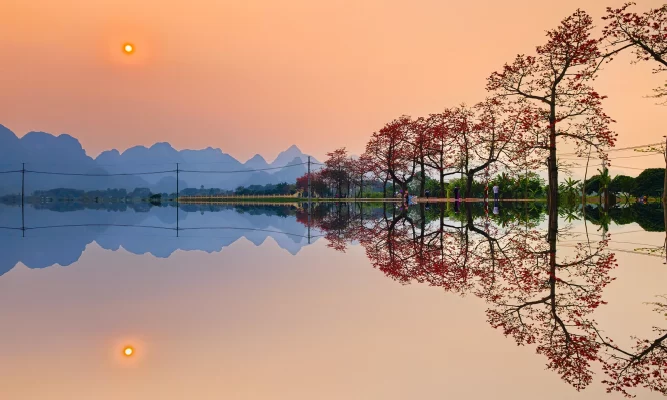
Blooming Kapok flowers paint sides of Day River red
Photographer Leo Hoang Vu, who lives in Hanoi, visited the village right at peak bloom and captured peaceful moments of riverside rural life. According to him, this location has been famous for years because of its ancient kapok trees.
“These trees not only create a distinctive landscape but are also deeply connected to the life, memories, and cultural identity of the local people,” he shared.
Beyond their visual beauty, kapok trees play an important role in the daily lives of villagers. The changes in the trees serve as natural signals for weather patterns and agricultural timing. When the flowers begin to fall, it marks the end of the late cold spell – often called “Ba Ban cold” – and indicates that temperatures are stabilizing, allowing farmers to enter the stage of tending their spring-summer rice crops.
This connection between nature and farming reflects the deep-rooted agricultural traditions of Northern Vietnam, where people rely on seasonal cues from the environment to guide their work. The kapok tree, therefore, is not just a decorative element but a living calendar embedded in rural life.
The row of kapok trees in Doan Nu Hamlet runs along a small road leading to the local cemetery, parallel to irrigation canals and rice paddies. According to folk beliefs, kapok trees have a spiritual role as guardians, often planted at village entrances or in open fields. Over decades, these ancient trees have been carefully preserved by the community, maintaining both their ecological and cultural significance.
During the blooming season, Doan Nu Hamlet becomes an attractive destination for visitors, especially thanks to its growing popularity on social media. Tourists frequently come on weekends to take photos and enjoy the tranquil countryside atmosphere.
As tourism develops, local residents have actively worked with authorities to protect the landscape. Households along the flower-lined road voluntarily collect waste, remind visitors not to climb trees or break branches, and contribute to preserving the site’s natural beauty.
This sense of shared responsibility highlights a sustainable approach to rural tourism, where local communities play a central role in maintaining both environmental integrity and cultural heritage.
Kapok flowers, also known as “silk cotton flowers” or “bombax flowers,” have five large, thick petals with a bright red or deep crimson color. Before blooming, the trees typically shed all their leaves, leaving bare branches covered entirely in blossoms.
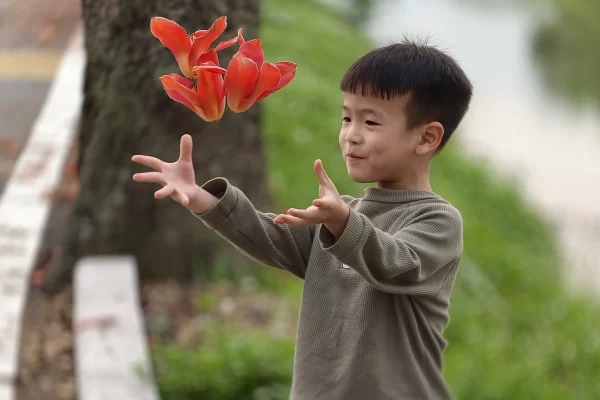
Kapok also known as “silk cotton flowers” or “bombax flowers”
The blooming cycle lasts about two to three weeks, usually starting in early March and ending by mid-April. Because of this short duration, the flowers appear densely clustered on the leafless branches, creating a vivid red canopy against the sky – a signature image of seasonal transition in Northern Vietnam.
This fleeting beauty is part of what makes the kapok season so special. Visitors often feel a sense of urgency to witness it before it disappears, turning the blooming period into a cherished annual event.
In a broader cultural context, kapok flowers are closely tied to memories of rural childhood, village life, and traditional landscapes. For many Vietnamese people, the sight of red kapok blossoms evokes nostalgia – images of village gates, riverbanks, and open fields.
The flowers also appear in folk sayings and poetry, symbolizing the shift from the cold of winter to the warmth of summer. Their blooming is not just a natural phenomenon but an emotional marker of time, deeply embedded in the cultural consciousness.
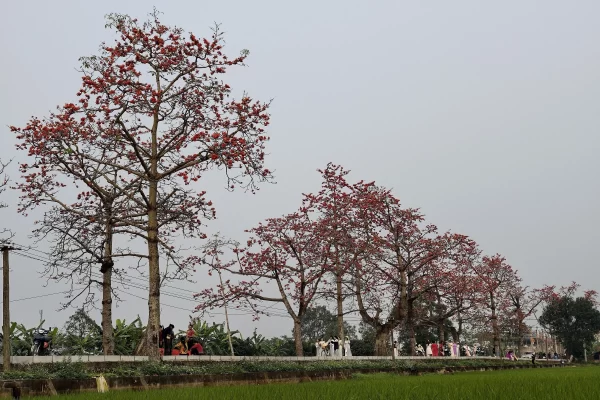
Kapok flowers streets become new check – in place
Today, as urbanization continues to expand, places like Doan Nu Hamlet offer a rare glimpse into the harmonious relationship between nature and human life. The vibrant red of kapok flowers standing beside green rice fields creates a vivid contrast that feels both timeless and poetic.
For visitors, the journey to this quiet village is not only about capturing beautiful photographs but also about experiencing a slower rhythm of life where nature, tradition, and community remain closely intertwined.
In this way, the blooming kapok trees do more than paint the countryside red; they tell a story of seasons, heritage, and the enduring beauty of rural Vietnam.
Noi Bai International Airport – Ha Noi Car Rental Services Car Rental ~ 1 hour

$50,00 Giá gốc là: $50,00.$41,00Giá hiện tại là: $41,00.

$15,00 Giá gốc là: $15,00.$13,00Giá hiện tại là: $13,00.